

Best Solar Inverter for Areas with Frequent KPLC Power Outages
Best Solar Inverter for Areas with Frequent KPLC Power Outages
For Kenyan homes affected by frequent KPLC interruptions, the best solar inverter is usually not a standard grid-tied model. A backup solar inverter Kenya solution built around a hybrid inverter, battery storage, and properly planned essential-load circuits is generally the more practical option.
A standard on-grid inverter can reduce daytime electricity costs, but it switches off when the grid fails. A hybrid inverter paired with batteries can keep selected home circuits running during an outage, making it better suited to households that need dependable power for lights, Wi-Fi, refrigeration, security, work, or basic comfort.
Why power outages change the inverter decision
Power outages are not always short or predictable. Kenya Power publishes planned-interruption notices for maintenance, network upgrades, new customer connections, and line replacement, and these outages can last several hours.
In addition to planned interruptions, Kenya has experienced broader grid-supply challenges. In the six months to December 2025, EPRA data cited in local reporting showed an average interruption duration of 8.39 hours per month, well above the regulator's 1.5-hour monthly target. Customers experienced an average of 3.52 interruptions per month during the same period.
For homeowners, that means choosing solar only for daytime bill savings may not be enough. The system should also be assessed for how it will respond when KPLC supply disappears.
Why standard grid-tied solar is not enough
A standard on-grid solar system uses panels and a grid-tied inverter to supply household loads during the day. When solar generation exceeds usage, the system may export surplus electricity where the connection arrangement allows it.
But during a KPLC outage, a normal grid-tied inverter shuts down. This anti-islanding protection is an electrical safety requirement that prevents the home solar system from sending power into utility lines while technicians may be working on them.
So, even if the sun is shining brightly, a standard on-grid system may not power your home during an outage.
That is why homeowners who want real backup should look for a backup solar inverter Kenya setup rather than only a grid-tie inverter.
The best option: hybrid inverter plus battery
A hybrid inverter combines three energy sources:
- Solar panels
- Battery storage
- KPLC grid electricity
During normal operation, the inverter uses available solar power for the home first. It can charge batteries with surplus solar generation and use the grid when solar or battery power is insufficient.
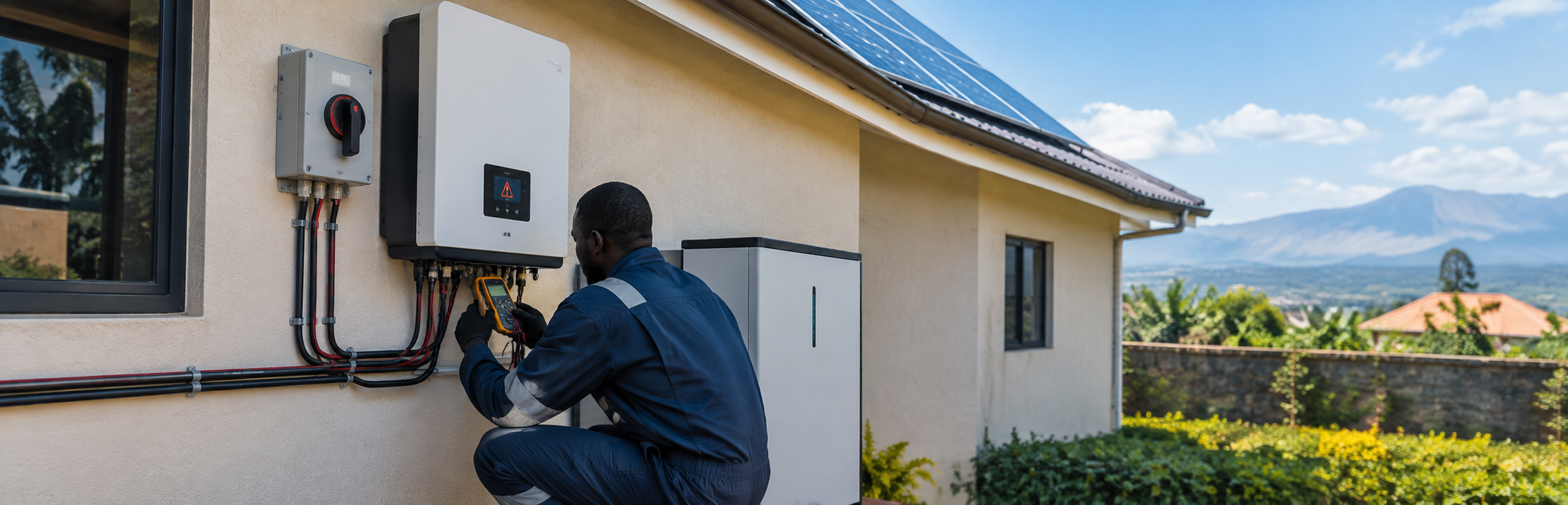
When KPLC power fails, the hybrid inverter automatically disconnects from the grid and supplies selected backup circuits from the battery and available solar energy. This means essential appliances can continue operating without manual intervention.
For outage-prone areas, this configuration gives households three important advantages:
- Lower daytime grid consumption through solar generation
- Battery backup during power cuts
- A grid connection as a fallback during long cloudy periods or unusually high demand
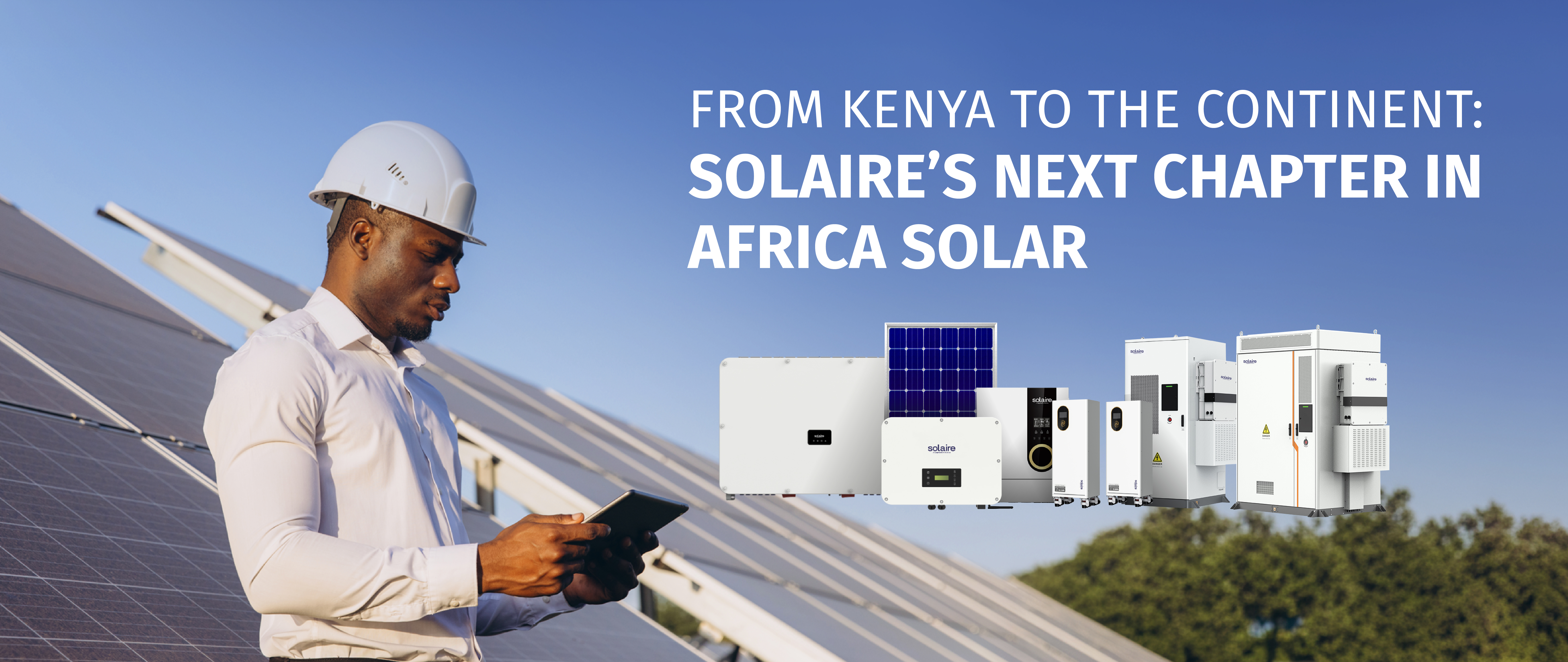
Solaire Africa's hybrid solutions are designed around this solar-battery-grid approach, while its broader portfolio includes systems for homes, businesses, and larger applications.
What should a backup solar inverter power?
The best system is not necessarily the one designed to power every appliance in the home. A cost-effective backup system usually prioritises essential circuits.
Typical backup loads may include:
- LED lights
- Wi-Fi router and phone-charging points
- Television
- Refrigerator
- Fans
- CCTV and security equipment
- Selected home-office sockets
- Basic water-pump requirements, where system capacity allows
Heavy appliances such as electric cookers, showers, kettles, irons, washing machines, large pumps, welders, and multiple air-conditioners can drain batteries quickly. They should only be included when the inverter and battery system have been specifically sized for them.
The right backup solar inverter Kenya system begins with a clear load list. Your installer should calculate which appliances need to run simultaneously, how many watts they consume, and how many hours of backup you want.
Why battery size matters as much as inverter size
The inverter rating tells you how much power can be supplied at one time. The battery capacity tells you how long the system can keep supplying that power.
For example, a 5 kW hybrid inverter may be able to run several appliances simultaneously, but a small battery bank may provide only limited backup duration. A larger battery bank may extend runtime substantially, but it also increases the overall project cost.
This is why a proper system design should consider:
- Essential appliance load in watts
- Peak simultaneous demand
- Desired backup time
- Battery capacity in kWh
- Solar-panel capacity for daytime battery charging
- Available roof space
- Future growth in household electricity use
A system that is too small may overload during an outage. A system that is too large may create unnecessary upfront expense. The right balance is based on real household behaviour.
Fast switching protects sensitive electronics
One major benefit of a quality hybrid inverter is fast switching from grid power to battery backup. When the transition is quick enough, routers, computers, CCTV systems, and other sensitive devices may continue operating without restarting.
Some hybrid backup systems are designed to switch in under 20 milliseconds, which can be effectively imperceptible for many electronic loads.
However, homeowners should not assume that every hybrid system offers the same transfer speed or backup capability. Before buying, ask the installer:
- What is the inverter's transfer time?
- Which circuits will be supported during an outage?
- Will Wi-Fi, CCTV, computers, and refrigeration remain live?
- What battery capacity is included?
- How long will the listed essential loads run?
Plan for outages that last longer
A battery-only backup system can eventually run down. For longer KPLC interruptions, solar panels become especially valuable because they can recharge the batteries during the day.
A properly designed hybrid system can use solar generation to run household loads directly while also restoring battery charge. This gives the system more endurance than a conventional inverter-and-battery arrangement that depends only on stored energy.
But this does not mean the system can run indefinitely without planning. Cloud cover, evening use, battery state of charge, appliance demand, and panel capacity all affect performance. Homes that need extended autonomy should consider a larger battery bank, energy-efficient appliances, load-prioritisation settings, and, where appropriate, a generator input for extreme contingencies.
What to look for before buying
When choosing the best backup system for frequent KPLC outages, homeowners should look beyond brand names and headline wattage. A strong backup solar inverter Kenya solution should include:
- Hybrid inverter capability, not only a grid-tie inverter
- Battery compatibility with approved battery types
- Pure sine-wave AC output for sensitive appliances
- Appropriate inverter capacity for simultaneous loads
- MPPT solar charging for stronger panel utilisation
- Fast transfer to backup power
- App or Wi-Fi monitoring where available
- Good warranty and local technical support
- Safe installation with correct breakers, earthing, and backup-circuit design
It is also wise to choose a system that can be expanded later. A growing household may add more solar panels, batteries, appliances, water pumps, or even EV charging over time.
The practical answer
For homes with frequent KPLC outages, a hybrid inverter with battery storage is generally the strongest choice. It offers more than solar savings: it provides planned backup, protects essential household routines, and gives the family more control over its energy use.
A standard grid-tied inverter can still be useful for homes that only want lower daytime bills and have reliable power supply. But where outages are regular, the better question is not simply "What is the cheapest solar inverter?" It is "What system will keep the important parts of the home running when the grid fails?"
That is why the best backup solar inverter Kenya option is usually a properly sized hybrid system, one that matches your essential loads, expected outage duration, battery needs, and future energy plans.