
How to Size a Solar Battery and Inverter System for a Kenyan Home
How to Size a Solar Battery and Inverter System for a Kenyan Home
Choosing a solar system is not about buying the biggest inverter or the largest battery you can afford. The right setup should match the electricity your household uses, the appliances you want to keep running, the length of expected KPLC outages, and the amount of solar energy your roof can generate.
Good solar system sizing Kenya begins with one simple principle: the inverter must handle the power you need at one time, while the battery must store enough energy to run those loads for the backup duration you want.
Start with the appliances you want to power
The first step in any inverter sizing guide is to list the appliances that will run on the solar and battery system.
For many Kenyan homes, essential loads may include:
- LED lights
- Wi-Fi router
- Television
- Refrigerator
- Fans
- Phone-charging points
- CCTV or security equipment
- Laptops and home-office devices
- Selected water-pump circuits
Write down the wattage of each appliance and estimate how many hours per day it runs. The wattage is usually found on the device label, user manual, or manufacturer specification.
To calculate daily energy use:
Daily Energy (Wh) = Appliance Power (W) × Hours Used Per Day
For example, a 100 W television used for five hours consumes:
100 × 5 = 500 Wh
That is equal to 0.5 kWh.
Repeat this for every appliance and add the results. This creates the home’s daily electricity requirement.
Calculate peak load separately
Daily energy use is not the same as peak load.
The battery is mainly sized around energy demand, measured in kWh. The inverter is mainly sized around the maximum power that may be used at the same time, measured in watts, kW, or kVA.
For example, a home may consume only 5 kWh in a day but still need a 3 kW inverter if the refrigerator, television, fans, pump, lighting, and kitchen appliances are all likely to run together.
A reliable inverter sizing guide should therefore add the wattages of appliances that could operate simultaneously.
For instance:
| Appliance | Typical power | Quantity | Simultaneous load |
|---|---|---|---|
| LED lights | 10 W | 8 | 80 W |
| Fans | 75 W | 3 | 225 W |
| Refrigerator | 200 W | 1 | 200 W |
| Television | 120 W | 1 | 120 W |
| Wi-Fi router | 15 W | 1 | 15 W |
| Laptop | 90 W | 2 | 180 W |
| Total running load | 820 W |
In this example, the home’s regular simultaneous load is about 820 W. But the final inverter should not be sized exactly at 820 W because refrigerators, pumps, and compressors can draw significantly higher power when starting.
Add headroom for surges and growth
An inverter should have enough capacity to handle short motor-starting surges and future appliance additions.
A practical rule is to add at least 20–30% capacity above the expected simultaneous load. Many Kenyan sizing references recommend a 20–25% margin for motor-starting current, system losses, and future expansion.
Using the earlier 820 W example:
820 W × 1.25 = 1,025 W
A 1.5 kW inverter may be the minimum practical starting point, while a 2–3 kW inverter may provide better flexibility if the home plans to add appliances, a water pump, or more backup circuits.
This is why inverter sizing guide decisions should not be based only on today’s appliance list. The system should also account for what the home may need in the next few years.
Size the battery for backup time
Battery sizing determines how long your appliances can run when solar production is low or KPLC power is unavailable.
The basic formula is:
Battery Capacity (kWh) = Required Backup Energy (kWh) ÷ (Usable Depth of Discharge × System Efficiency)
For lithium batteries, a conservative usable depth of discharge may be around 80–90%, depending on the manufacturer’s specifications. System efficiency also accounts for inverter and wiring losses.
For example, assume a home needs to run an average essential load of 1 kW for five hours during an outage:
1 kW × 5 hours = 5 kWh
If the battery is designed for 90% usable depth of discharge and an estimated 90% system efficiency:
5 ÷ (0.90 × 0.90) = 6.17 kWh
The home would therefore need a battery bank of roughly 6–7 kWh to provide that five-hour backup target under normal conditions.
A battery should not be sized only around the inverter capacity. A 5 kW inverter can run a large load, but if it is paired with only a 5 kWh battery, it may support that load for a relatively short time.
Choose the right battery voltage
Battery voltage matters because the inverter and battery must be compatible.
Smaller systems often use 12 V or 24 V battery banks, while larger residential systems generally use 48 V batteries. A 48 V setup is common for 3–5 kW and larger hybrid systems because it can support higher loads with lower current than smaller-voltage systems.
For example, a 5 kW inverter operating from a 48 V battery may draw more than 100 A under heavy load. The battery must be rated to safely provide that continuous current, as well as higher short-duration surge current.
Before buying, confirm:
- Battery nominal voltage and full working-voltage range
- Inverter battery-voltage range
- Battery continuous discharge-current rating
- Battery peak discharge-current rating
- Inverter charging-current limit
- Battery Management System, or BMS, communication compatibility
- Number of batteries that can be connected in parallel
Correct battery sizing is not just about kWh. It is also about whether the battery can safely deliver the required power.
Size the solar panels too
The solar panels must generate enough energy to run daytime loads and recharge the batteries.
A basic planning formula is:
Solar Array Size (kW) = (Daily Energy Requirement (kWh) ÷ Peak Sun Hours) × Loss Factor
Many Kenyan sizing references use around five peak-sun hours as a general planning assumption, then add a 20–30% margin for losses from temperature, dust, inverter efficiency, wiring, and battery charging.
For example, if the home requires 10 kWh per day:
10 ÷ 5 = 2 kW
Adding a 25% allowance:
2 × 1.25 = 2.5 kW
A solar array of approximately 2.5–3 kW may be considered as a preliminary estimate. The actual design should be based on the property’s location, roof orientation, shading, panel model, backup expectations, and seasonal conditions.
A practical example for a Kenyan home
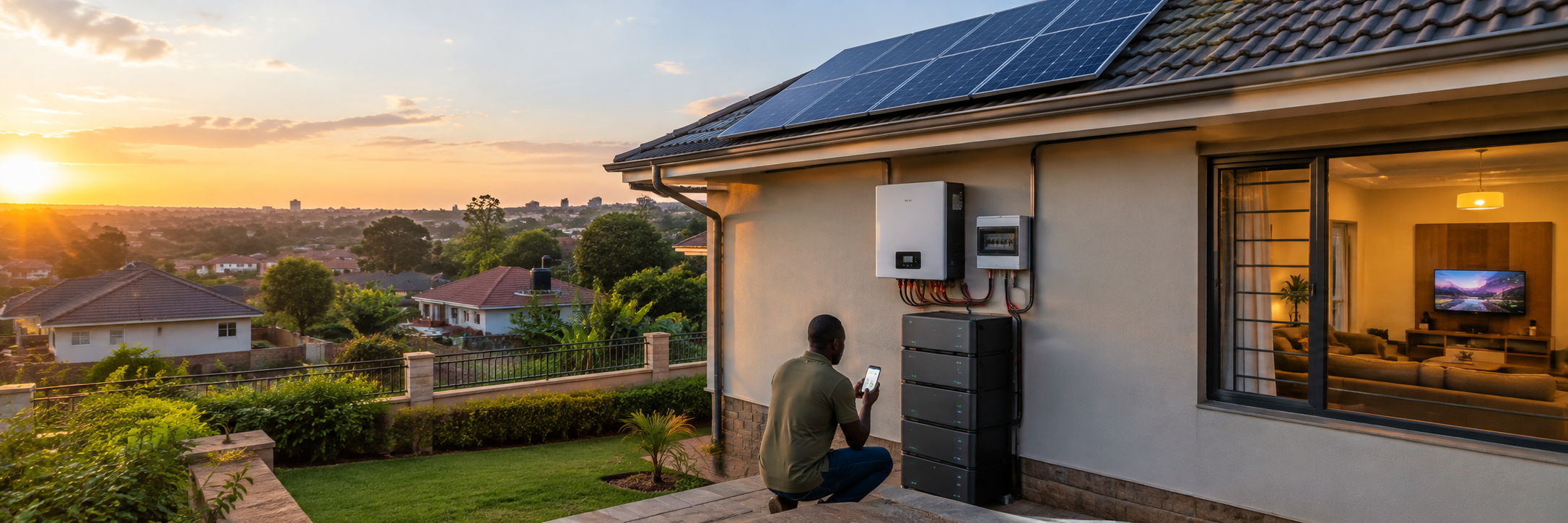
Consider a family that wants backup for lights, fans, Wi-Fi, refrigerator, television, two laptops, and selected charging points.
Its combined simultaneous running load may be around 1–1.5 kW. With a 25% sizing margin, the household may consider a 2 kW or 3 kW hybrid inverter.
If the household wants around five hours of essential backup at an average 1 kW load, it may need roughly 6–7 kWh of usable battery capacity after accounting for depth of discharge and system losses.
If total daily consumption is around 8–10 kWh, a 2.5–3 kW solar array may be an initial planning range, subject to detailed site design.
This is only an illustration. Homes with water pumps, electric cooking, large refrigeration, air-conditioning, workshop equipment, or multiple floors may need a much larger system.
Decide which loads are essential
A well-designed system does not always try to back up the entire home.
Heavy appliances can drain batteries very quickly. Electric showers, kettles, induction cookers, irons, washing machines, water heaters, welders, and multiple air-conditioners should only be placed on backup circuits if the inverter, batteries, and solar array have been specifically designed to support them.
A better approach is to create an essential-load panel. This allows the inverter and battery to support the most important circuits during an outage while non-essential loads remain connected only to the grid.
This can make solar system sizing Kenya more affordable and more reliable.
Common sizing mistakes to avoid
Homeowners should avoid these common mistakes:
- Choosing an inverter only by house size rather than actual load
- Ignoring appliance start-up surges
- Sizing the battery only by inverter kW rating
- Forgetting about night-time electricity use
- Including heavy appliances without increasing battery and inverter capacity
- Assuming every battery is compatible with every hybrid inverter
- Using generic peak-sun-hour assumptions without considering shading
- Planning no margin for future appliances or additional family demand
- Expecting an on-grid inverter to provide backup during a KPLC outage
A strong inverter sizing guide helps prevent overspending on the wrong equipment as well as under-sizing a system that will disappoint during an outage.
The practical takeaway
The right solar system starts with three questions:
- What appliances need to run at the same time?
- How long should they run when KPLC power is unavailable?
- How much solar energy does the home use each day?
The inverter answers the first question. The battery answers the second. The solar panels answer the third.
For Kenyan homes, correct solar system sizing Kenya means matching power capacity, energy storage, and solar generation in one coordinated design. With realistic battery sizing, a practical inverter sizing guide, and a clearly defined list of essential loads, a household can build a solar system that delivers useful savings and dependable backup without paying for unnecessary capacity.