
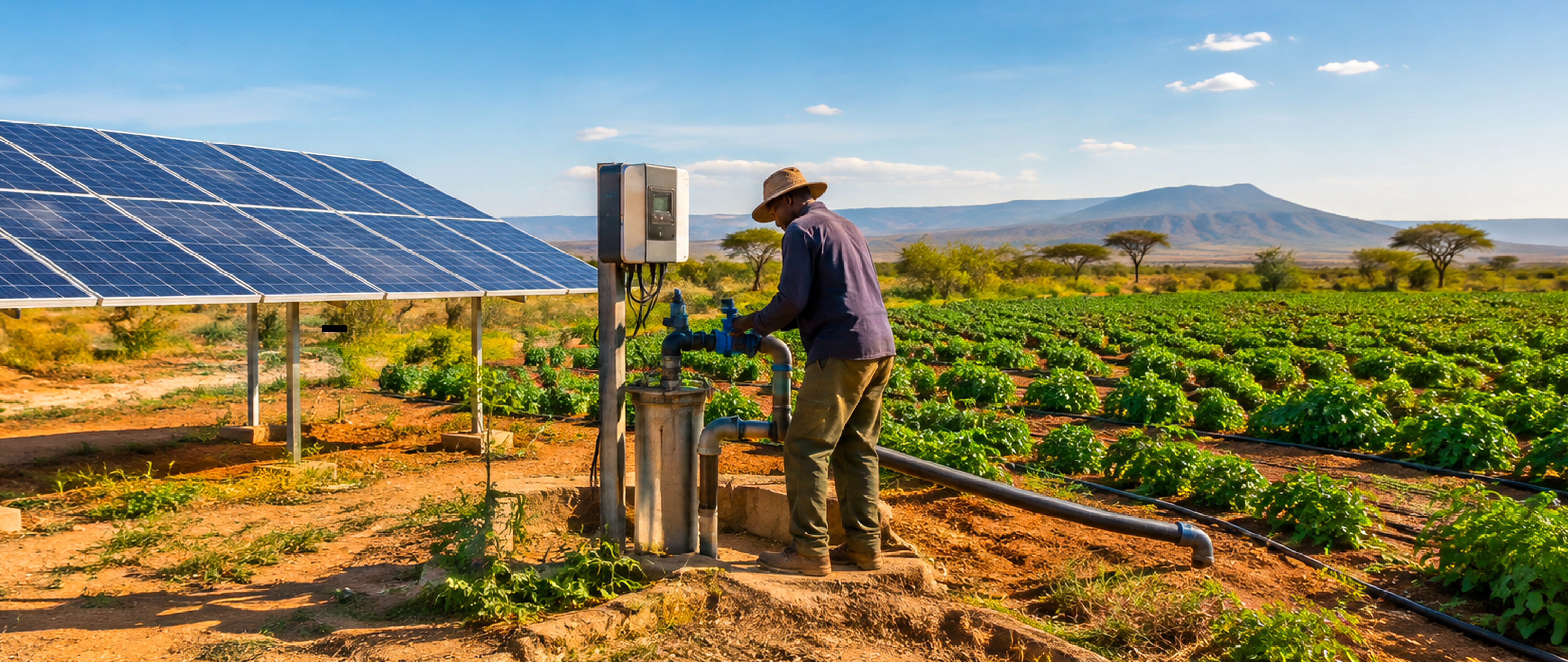
Best Solar Inverter Solutions for Farms and Agricultural Operations in Africa
Best Solar Inverter Solutions for Farms and Agricultural Operations in Africa
For farms across Africa, a solar system is not simply an electricity-saving tool. It can support irrigation, borehole pumping, livestock operations, cold storage, crop processing, lighting, security, and remote-site power. Choosing the right solar inverter for farms is therefore one of the most important decisions in an agricultural solar project.
The best inverter solution depends on the farm's real needs: water source, pump type, motor rating, irrigation schedule, grid availability, storage needs, and whether the farm requires solar only during the day or reliable power around the clock.
Why farms need a different solar approach
A home solar system is often designed around lights, refrigeration, television, Wi-Fi, and basic appliances. A farm may need to operate pumps, motors, processing equipment, water-treatment systems, electric fencing, cold rooms, or workshops.
These loads can be larger, more variable, and more demanding than typical household appliances. Motors in particular require high starting current, meaning an inverter must be sized not only for running power but also for start-up surges.
That is why a solar inverter for farms should never be selected only because it has a low price or a high kW rating. It needs to match the actual electrical demand and operating pattern of the agricultural site.
Start with water and irrigation needs
For many farms, irrigation is the main reason to install solar. Solar-powered irrigation systems use photovoltaic panels to generate electricity that operates pumps for water abstraction, lifting, distribution, or irrigation.
Before selecting an inverter, the farm should assess:
- Water source: borehole, river, dam, tank, shallow well, or municipal supply
- Pump type: submersible, surface, centrifugal, booster, or pressure pump
- Pump motor rating in kW or horsepower
- Required water flow in litres per hour or cubic metres per hour
- Total dynamic head, including depth, lift, pressure, and pipe losses
- Irrigation method: drip, sprinkler, centre pivot, or flood irrigation
- Daily pumping hours and seasonal water demand
- Availability of grid or generator backup
These details determine whether the project needs a dedicated solar pump inverter, a standard hybrid inverter, or a larger commercial solar system.
Dedicated solar pump inverters for irrigation
A dedicated pump inverter is often the best solar inverter for farms where water pumping is the main objective.
Unlike a standard household inverter, a solar pump inverter is designed to control the speed and operation of a motor. It manages the variable electricity generated by solar panels and adjusts voltage and frequency to suit the pump motor's requirements.
This type of inverter can be especially useful for borehole pumps, surface pumps, drip irrigation systems, sprinkler systems, and agricultural water-transfer applications.
A good pump inverter can offer:
- MPPT-based solar power tracking
- Soft-start capability for motors
- Variable-frequency control
- Dry-run protection
- Low-water or tank-full protection
- Compatibility with sensors and float switches
- Grid or generator backup options, depending on the model
- Monitoring for pump performance and fault alerts
For direct daytime irrigation, a dedicated solar-pump system may not require batteries. Solar panels power the pump during sunlight hours, and water can be stored in an elevated tank or reservoir for later use. In many cases, storing water is more cost-effective than storing electricity in batteries.
Hybrid inverters for farm backup
A hybrid inverter is a stronger option when the farm needs more than irrigation.
For example, a dairy farm may need refrigeration, lighting, pumps, security systems, milk-handling equipment, and staff accommodation power. A poultry farm may need lighting, ventilation, feeders, water pumps, and monitoring equipment. A horticulture business may require cold storage, packaging, and irrigation.
In these cases, a hybrid solar inverter for farms can work with solar panels, battery storage, and the grid or a generator. This allows the farm to use solar power during the day, store energy in batteries, and keep essential loads operating during outages.
Hybrid systems are particularly valuable where:
- Grid supply is available but unreliable
- The farm needs night-time power
- Essential equipment must operate during outages
- Battery backup is required for critical loads
- The site has a generator and wants to reduce fuel consumption
- The farm plans to add solar capacity or storage later
The right design may use batteries only for essential loads rather than attempting to power every motor and machine during an outage.
Grid-tied systems for established farms
For farms with reliable grid supply and high daytime electricity use, a grid-tied solar inverter can be a practical solution.
This approach is often suitable for commercial farms that run irrigation pumps, processing equipment, packhouses, refrigeration, or workshops mainly during daylight hours. Solar generation reduces the amount of electricity purchased from the grid while the grid remains available as a fallback for low-solar periods or heavier demand.
A grid-tied system may be more cost-effective than a battery-backed setup because it does not require a large battery bank. However, it normally shuts down during a grid outage for safety reasons.
This means it is ideal for bill reduction but not for backup. Farms that need continuous power for critical operations may need a hybrid system, generator integration, or a dedicated backup strategy.
Matching inverter size to farm equipment
Sizing is one of the most important parts of choosing a solar inverter for farms.
The inverter must be able to handle:
- Total running load
- Motor-starting current
- Pump speed and pressure requirements
- Number of loads running at the same time
- Solar-panel capacity
- Battery charging requirements, if storage is included
- Future expansion plans
A 5 HP pump, for example, should not be matched only with a 5 HP-equivalent inverter. The installer must consider the pump's start-up behaviour, voltage, current, water head, solar-array sizing, and whether other farm loads will operate simultaneously.
An undersized inverter can trip or fail to start the motor. An oversized system can add unnecessary cost. A proper site assessment and pump-data review are essential.
The role of solar batteries on farms
Not every farm solar system needs batteries.
For daytime irrigation, direct solar pumping combined with water storage can often be the most practical setup. Water stored in tanks can be used later for irrigation or livestock without requiring large electrical battery banks.
But batteries become useful when the farm needs electricity after sunset or during outages. This may include:
- Security lighting and cameras
- Refrigeration and cold rooms
- Dairy equipment
- Poultry-house ventilation
- Staff housing
- Communications equipment
- Electric fencing
- Essential water pumping
The key is to identify critical loads. A well-designed hybrid system may keep essential equipment running while allowing non-critical or high-energy loads to remain off during a prolonged outage.
Why monitoring and maintenance matter
Farm solar systems are often installed in demanding environments. Dust, heat, moisture, insects, rodents, vibration, and long cable runs can affect performance.
The inverter should therefore be installed in a protected, ventilated location with proper earthing, surge protection, cable management, and weather protection.
Farm operators should also look for monitoring features that can show:
- Solar generation
- Pump operation
- Battery state of charge
- Grid or generator use
- Fault codes
- Daily energy consumption
- System alerts
Remote monitoring is particularly useful for farms with multiple sites or equipment located far from the main building.
Questions to ask before choosing
Before investing in a solar inverter for farms, ask the installer:
- What loads need to run, and at what times?
- Is the main requirement irrigation, farm power, backup, or all three?
- What pump type, motor rating, and water head are involved?
- Does the system need batteries, or can water storage meet the requirement?
- Can the inverter support motor-starting current?
- Will the system work during a grid outage?
- Is grid or generator backup needed?
- What happens during cloudy weather or peak irrigation demand?
- Is remote monitoring included?
- What local warranty and maintenance support are available?
The practical answer
The best solar inverter for farms depends on the farm's operating reality.
A dedicated solar pump inverter is often ideal for daytime irrigation and borehole pumping. A grid-tied inverter can reduce electricity costs for farms with stable grid access and high daytime demand. A hybrid inverter with batteries is better for farms that need essential backup power, night-time operation, or protection from unreliable grid supply.
The strongest agricultural solar systems are not built around a generic inverter package. They are designed around water, equipment, operating hours, storage needs, and the farm's long-term production goals.
For farm owners, solar can be more than a way to reduce power costs. With the right inverter, it can improve water access, reduce diesel dependence, protect critical operations, and support more reliable agricultural productivity across Africa.